
01 · The story in the thread
Begin before the pattern
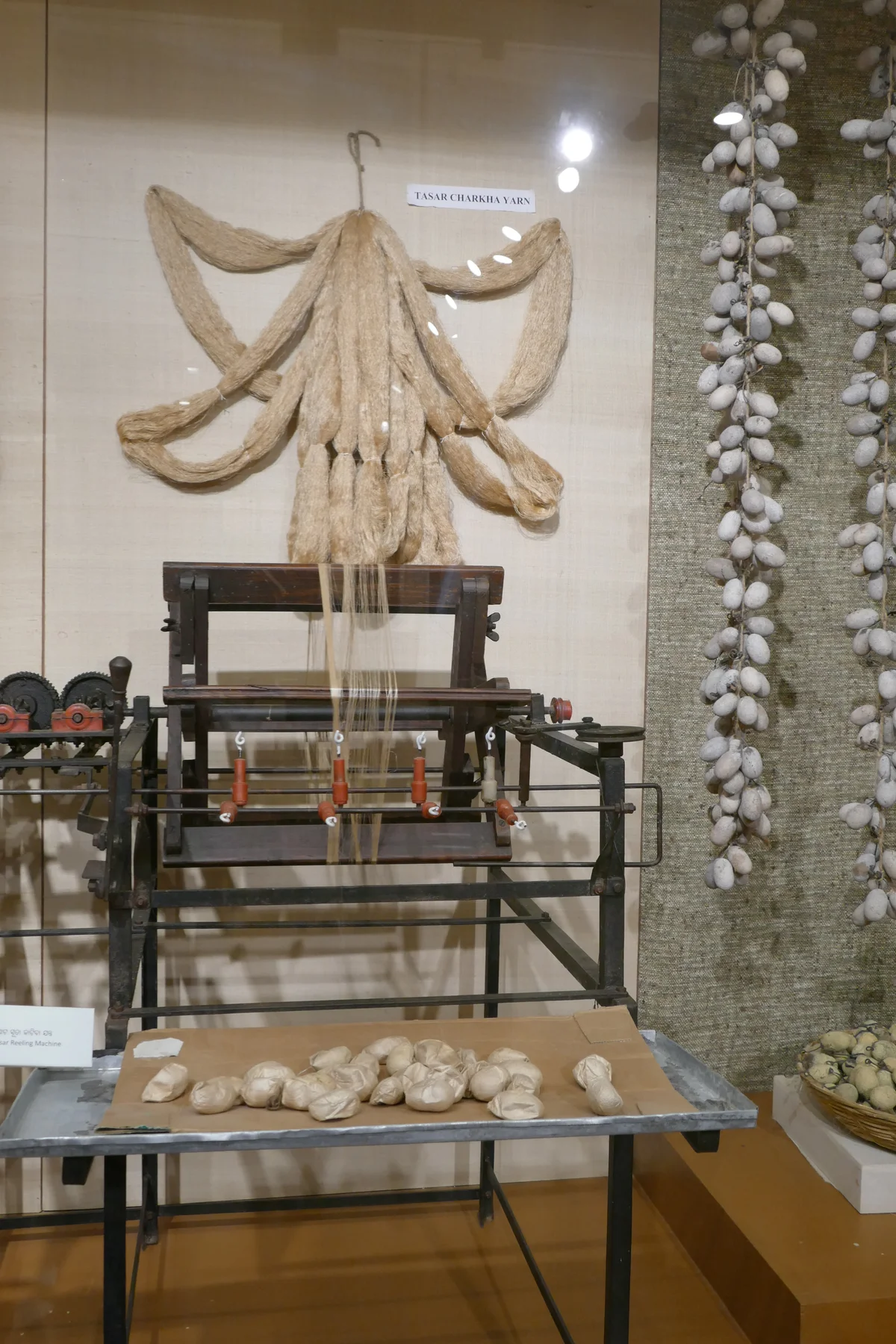
Look at the loops of yarn in the museum photograph. With no painted scene or elaborate border to follow, the material itself takes centre stage: the loose strands, the hanging weight, the light caught along a thread.
This is a museum display, not a working workshop. The photographed display is labelled Tasar Charkha Yarn. It was recorded at the Odisha Crafts Museum in 2018. It gives us a place to begin looking, without pretending to show today’s production or identify a particular weaver.
02 · The story in the thread
The story has leaves in it
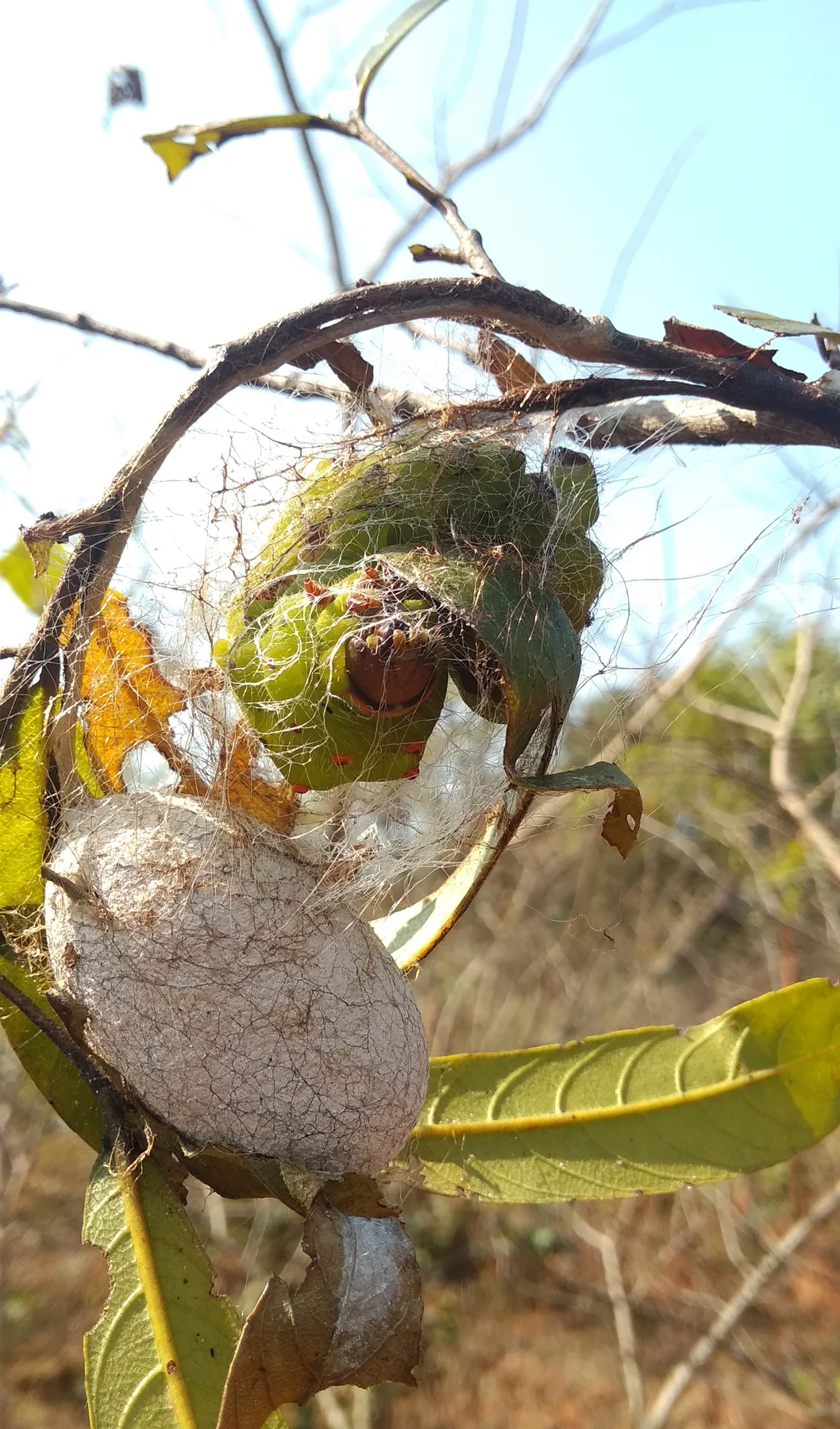
The Central Silk Board’s Keonjhar reference lists Arjun and Asan as Tasar host plants, occurring in forests and raised plantations. A silk story can therefore begin with the plants and people supporting the silkworm, well before the loom.
Durga Soren’s photograph brings that earlier world close: fine strands cross a branch beside a cocoon. The photographer identifies the scene as Tasar at Chandua in Odisha; we have not independently identified the species or host tree in the image.
03 · The story in the thread
A cocoon is not yet a cloth
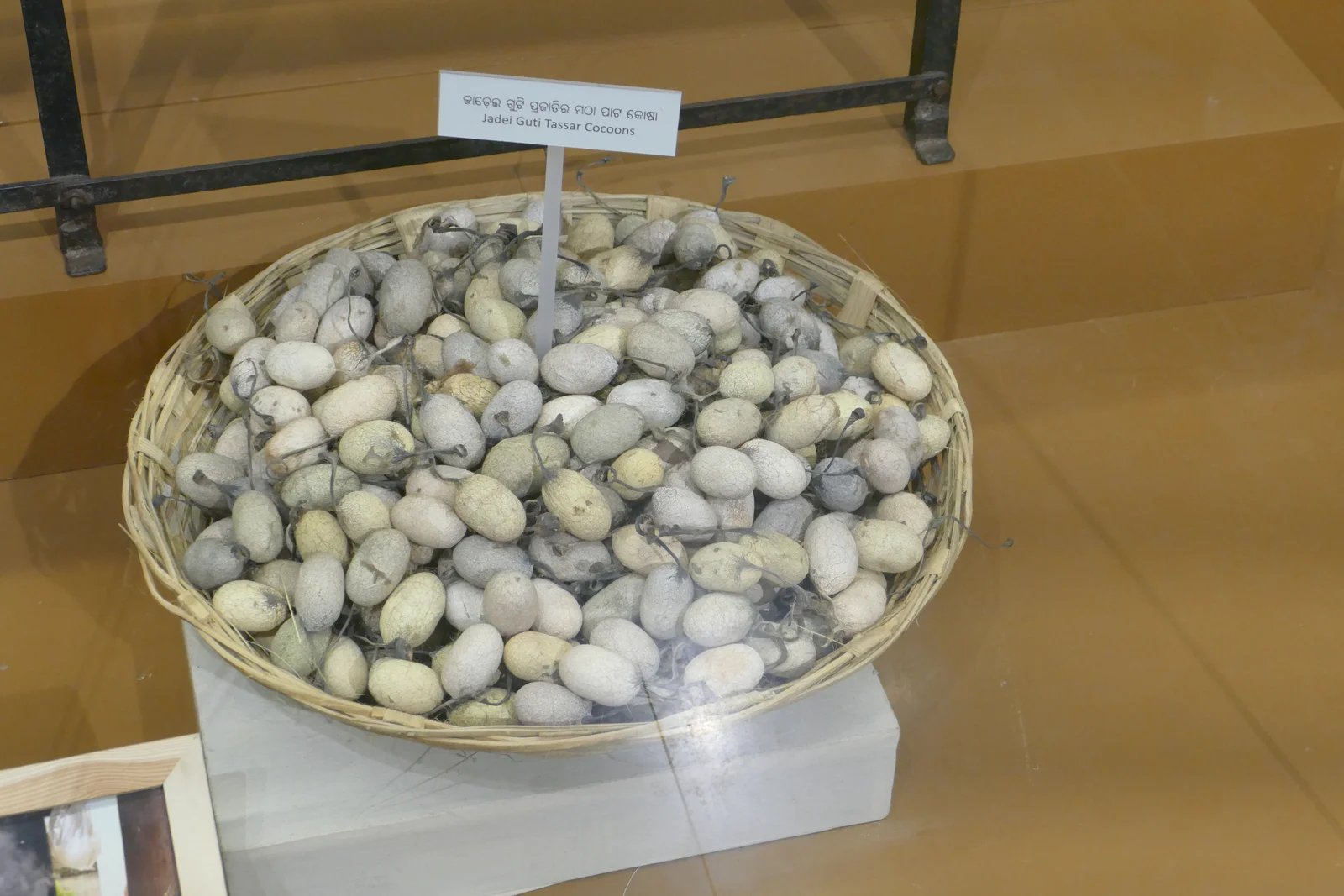
The Central Silk Board’s technical account separates cocoon processing, reeling, spinning and preparation for weaving. Making usable yarn is work in its own right; weaving is another stage. Different tools and yarn types need not follow one identical sequence.
Beside the museum’s basket of cocoons, imagine tracing one strand forward. If you meet someone working with Tasar, ask which stage they know best. Can they show the difference between the cocoon, the prepared yarn and the finished fabric? The most revealing object may be the unfinished one.
04 · The story in the thread
Put the right Gopalpur on your map
Odisha’s handloom department lists Mayurbhanj, Gopalpur, Fakirpur and Mankidia for Tassar sarees and furnishing textiles. Its cluster table places Rasulpur (Gopalpur) in Jajpur district. That is the Gopalpur weaving connection here, distinct from Gopalpur-on-Sea in Ganjam.
Treat these as research leads, not open-door workshop listings. A weaving place does not prove where a particular cocoon was raised or its yarn processed. Confirm the village, host, address and activity directly before travelling; the locations do not form a checked day route.
05 · The story in the thread
Learn a name behind each stage
Begin with the person in front of you: what do they make, and what do they receive from someone else? Ask where the yarn comes from, who prepared it, and what choices shape this fabric. Record names and stories only with permission.
Tasar identifies a silk material; it does not by itself tell you the weave, blend, dye, finishing or treatment of the cocoons. If those details matter to you, ask for evidence for this particular piece. A natural-looking colour is not a certificate, and Tasar alone does not establish an ahimsa or cruelty-free process.
06 · The story in the thread
Choose something you will live with
If handling a sample is welcome, look at how it falls and how the surface changes in the light. Think about how you will actually use it, then ask whether this fibre, weight and construction suit that use.
Ask for the fibre composition, any blend, the maker’s preferred credit and a receipt. Request care advice for the actual dyes and finish: cleaning, drying, storage and possible colour transfer. Agree measurements, price, lead time and return terms before commissioning a piece.
Sources, photographs & editorial notes
Research checked 2026-10-01. Photographs document the subjects and dates in their captions; they do not establish current workshop access. Process descriptions are attributed to their sources. No named workshop, current appointment, price or material certification has been verified. Odia names and craft terminology await local review.
- Tasar silk display at Odisha Crafts Museum · Kritzolina
Documentary photograph dated 29 October 2018 inspected. Display label reads Tasar Charkha Yarn; no proof of current exhibit availability or origin of each material.
- Varieties of Silkworm Food Plants · Central Silk Board, Keonjhar
Government district portal retrieved directly 1 October 2026. Tasar host-plant rows name Arjun and Asan and distinguish forest occurrence from raised plantations. Undated reference; not a current farm inventory.
- Processing of Tasar Cocoons · Central Silk Board / CSTRI
Government technical account describes cocoon processing, reeling, spinning and weaving preparation. Used only for a general material-to-yarn explanation; not proof of a specific Odisha workshop’s method.
- Important Handloom Centers · Government of Odisha
Department list identifies Bargarh tie-dye production and Nuapatna silk Khandua and calligraphy textiles. No current workshop access verified.
- Important Handloom Clusters · Government of Odisha
Indexed government table inspected 1 October 2026: Rasulpur (Gopalpur) is listed under Jajpur. Direct retrieval timed out. No current cluster membership, workshop address or access verified.

Tasar yarn and reeling equipment · Odisha Crafts Museum, 29 October 2018. Museum display, not a working workshop. · Kritzolina · CC BY-SA 4.0. Orientation corrected, resized and converted to WebP; full frame retained. Derivative available under CC BY-SA 4.0.
Identified by photographer Durga Soren as Tasar at Chandua, Odisha · 2 February 2020. The species and host tree were not independently identified. · Durga Soren · CC BY-SA 4.0. Orientation corrected, resized and converted to WebP; full frame retained. Derivative available under CC BY-SA 4.0.

Tasar cocoons at the Odisha Crafts Museum · photographed on 29 October 2018. · Kritzolina · CC BY-SA 4.0. Orientation corrected, resized and converted to WebP; full frame retained. Derivative available under CC BY-SA 4.0.

Utkal Project knowledge base. Founder & Editor-in-Chief: Ahimanikya Satapathy. Prepared with AI assistance under the Founder’s editorial direction. Specialist language and maker review remain open.