
01 · The story in the thread
Read with your eyes; then ask
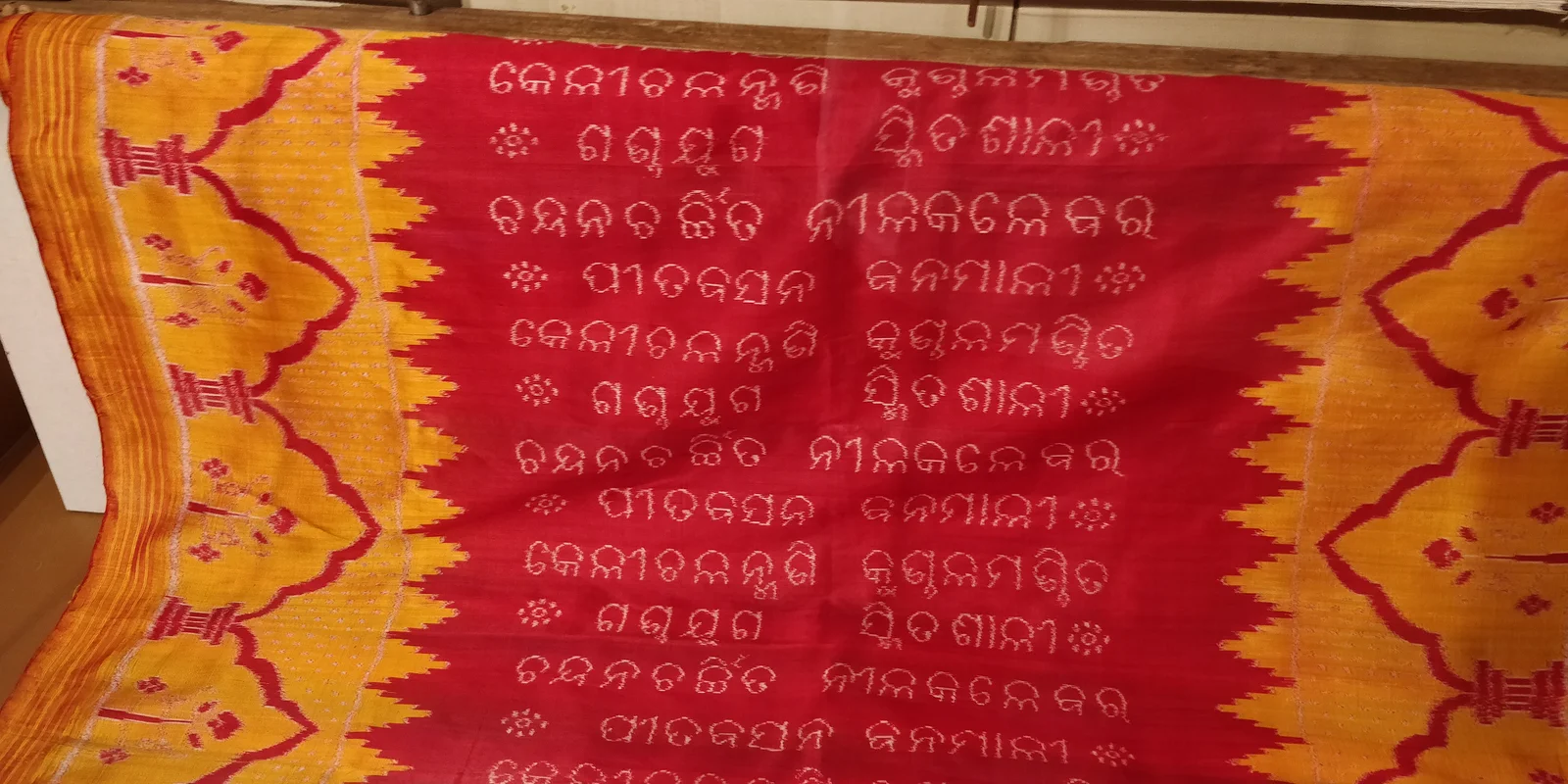
The photograph is identified by its creator as a Gita Govinda Khandua. Notice how the lettering sits within the woven surface. The image invites a question that a shop label may never answer: what does this particular cloth say?
Ask a knowledgeable reader or the maker to identify the passage. We have not transcribed or translated the photographed text, or established the individual weaver.
02 · The story in the thread
A literary thread reaches Puri
Sakshi Gambhir’s Nuapatna documentation for IDC, IIT Bombay connects woven Gita Govinda verses and calligraphic cloth with offerings to Jagannath at Puri. It offers a way to read these textiles as part of a devotional and literary tradition.
That connection does not give every Khandua the same words, purpose or ritual history. Let a specific piece lead to its own explanation.
03 · The story in the thread
Nuapatna: where the pattern is planned
The state handloom department names Nuapatna for silk Khandua and calligraphy textiles. Dsource’s process account describes calculating the pattern for the cloth’s thread density, tying sections of weft for resist-dyeing, and weaving, with several people contributing to the work.
A finished textile hides many separate decisions. Ask which part of the process the person you meet carries out, and whether there is an unfinished stage they are comfortable showing. A workshop visit needs an invitation; temple access follows its own rules.
04 · The story in the thread
Carry the words carefully
If the cloth carries lettering, ask for its language, passage and meaning in writing, with the maker’s permission. Choose a piece for how you will use and care for it; do not assume a ceremonial textile is ordinary decorative fabric.
Ask about fibre, yarn, dyes and any finishing. Request evidence for a certification claim and keep the maker or seller’s details with the receipt. A photograph, a place name or the word natural cannot certify a particular product.
Ask for care instructions specific to this piece: washing or cleaning, drying, storage and whether colours may transfer. Agree the price, measurements, lead time, delivery and return terms before ordering.
Sources, photographs & editorial notes
Research checked 2026-10-01. Photographs document the subjects and dates in their captions; they do not establish current workshop access. Process descriptions are attributed to their sources. No named workshop, current appointment, price or material certification has been verified. Odia names and craft terminology await local review.
- Ikat Textiles of Nuapatna · Sakshi Gambhir, IDC IIT Bombay
Attributed introduction inspected 1 October 2026. Temple/calligraphy connection used; historical manuscript not independently inspected. Unrelated spam navigation ignored.
- Important Handloom Centers · Government of Odisha
Department list identifies Bargarh tie-dye production and Nuapatna silk Khandua and calligraphy textiles. No current workshop access verified.
- Ikat Textiles of Nuapatna: process · IDC IIT Bombay
Process overview inspected: planning thread density, tying selected weft sections, dyeing, weaving and shared work. No modern supplier certification inferred.
Gita Govinda Khandua · photographed in 2018; identified by the photographer. · Prateek Pattanaik · CC BY-SA 4.0. Resized and converted to WebP; full frame retained. Derivative available under CC BY-SA 4.0.

Utkal Project knowledge base. Founder & Editor-in-Chief: Ahimanikya Satapathy. Prepared with AI assistance under the Founder’s editorial direction. Specialist language and maker review remain open.