
01 · The story in the thread
Begin with the people
The Development Commissioner for Handlooms identifies the Mirgan community of Kotpad in Koraput with this textile tradition. Its account describes aul-root dyes and a palette of red, maroon, brown and black.
Look at these colours as the beginning of a conversation. Who prepared this yarn? Who dyed it? Who wove it? A place name tells only part of the story.
02 · The story in the thread
A patient route from root to yarn
The government report describes preparation, repeated washing and drying, and dyeing before weaving. It names both cotton and tussar among the materials used in Kotpad textile work. This is a documented tradition; the exact fibre and process of a piece for sale still need to be established.
Ask a maker to describe their own sequence in their own words. Natural dye is a process claim, not proof of certified organic fibre, a tested environmental benefit or a universal care method.
03 · The story in the thread
A small figure can open a larger world
Dastkari Haat Samiti’s 2017 documentation, credited to Jaya Jaitly and photographer Chirodeep Chaudhuri with artisan Gobardhan Panika and the community, shows fish, crabs, vessels and other everyday forms in Kotpad textiles.
Let the maker name the motif before assigning it a meaning. Two similar-looking shapes may have different stories; a photograph cannot tell us what a community believes.
04 · The story in the thread
Make time for the moving story
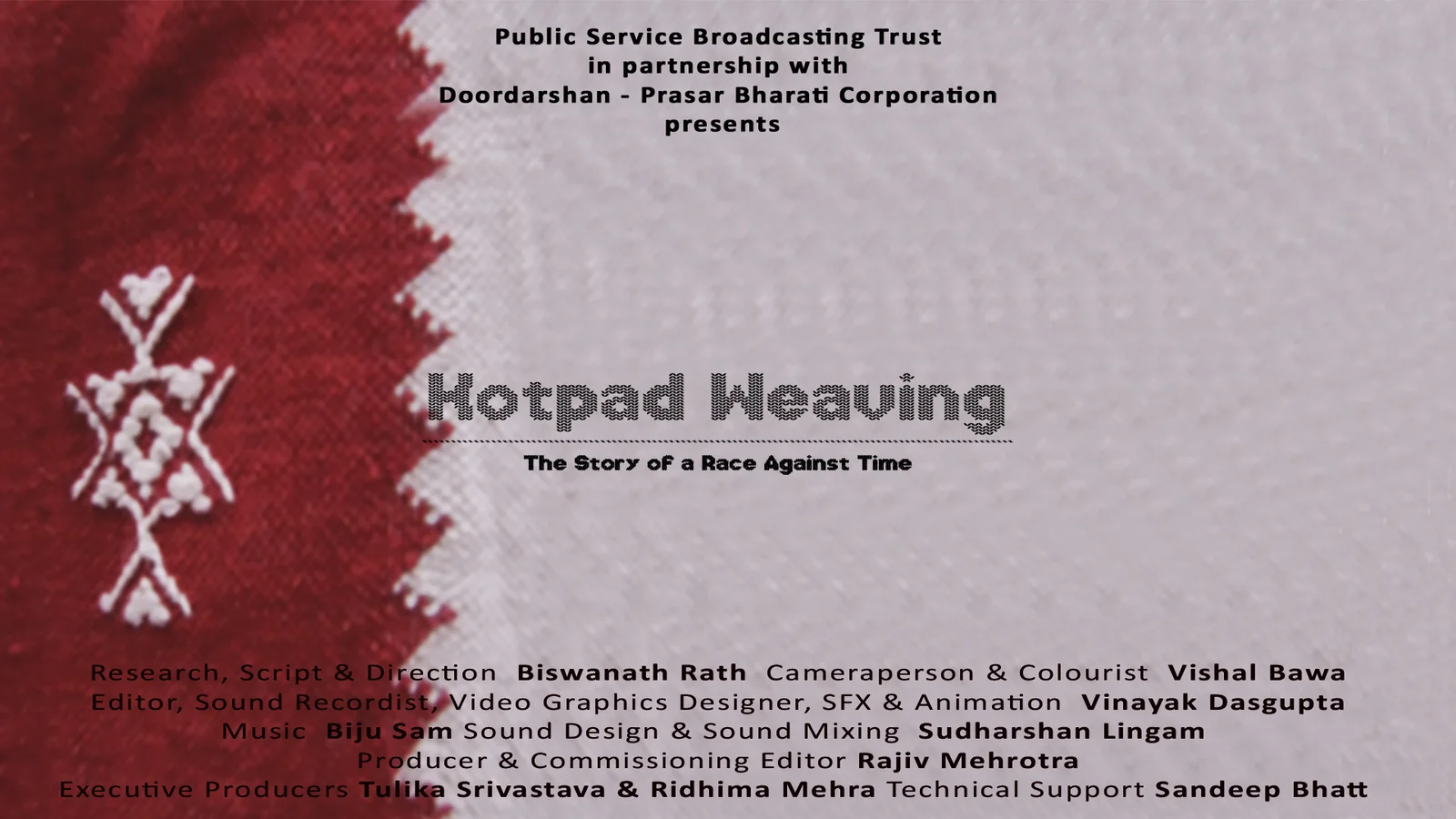
PSBT lists Biswanath Rath’s 2018 documentary Kotpad Weaving: The Story of a Race Against Time as a 29-minute film in Odia and English about the textile tradition and natural dyeing. The cover shown here is its release poster.
Follow the producer’s page for the film and viewing information. We have not reviewed the complete film or verified current screening availability. The poster’s reuse licence does not extend to the film itself.
05 · The story in the thread
Bring questions, leave room for answers
Ask who tied, dyed and wove this piece, where the work happened, and how the maker would like to be credited. Arrange a visit and any demonstration fee before travelling; ask before photographing people, homes or designs.
Ask about fibre, yarn, dyes and any finishing. Request evidence for a certification claim and keep the maker or seller’s details with the receipt. A photograph, a place name or the word natural cannot certify a particular product.
Ask for care instructions specific to this piece: washing or cleaning, drying, storage and whether colours may transfer. Agree the price, measurements, lead time, delivery and return terms before ordering.
Sources, photographs & editorial notes
Research checked 2026-10-01. The lead image is a film poster; its licence does not cover the film. Process descriptions are attributed to their sources. No named workshop, current appointment, price or material certification has been verified. Odia names and craft terminology await local review.
- Sustainability in the Handloom Traditions of India · Development Commissioner (Handlooms)
Original PDF recovered 1 October 2026; PDF page 49, printed page 36, read and visually inspected. Earlier indexed-only access is superseded for this bounded section. Institutional account, not product certification.
- The Colours and Motifs of Kotpad textiles · Dastkari Haat Samiti
2017 documentation with text by Jaya Jaitly, photographs by Chirodeep Chaudhuri and artisan credit to Gobardhan Panika and community. Read 1 October 2026. Photographs linked at source, not reproduced.
- Kotpad Weaving: The Story of a Race Against Time · PSBT
Producer listing inspected 1 October 2026: Biswanath Rath, 2018, 29 minutes, Odia and English. Film itself not reviewed; listing does not grant film reuse rights.
Release poster for Kotpad Weaving (2018), directed by Biswanath Rath · not a workshop photograph. · Seven5carrom · CC BY-SA 4.0. Resized and converted to WebP; full frame retained. Derivative available under CC BY-SA 4.0.

Utkal Project knowledge base. Founder & Editor-in-Chief: Ahimanikya Satapathy. Prepared with AI assistance under the Founder’s editorial direction. Specialist language and maker review remain open.